
This fall, with the help of Maria Renée, a Tucson-based artist, conservationist, and grief consultant, SIA is hosting a series of talks and exercises on tending environmental grief. In case you missed the first talk, you can watch a recording. A follow-up webinar on Dec. 10 will let participants share their reflections on a series of prompts, the third of which is presented here. Scroll to “The Invitation” below to try it.
Finding Presence and Complexity on a Landscape
A few years ago, I visited Las Cienegas National Conservation Area, a vast grassland threaded by Cienega Creek and its tributaries and surrounded by hills that connect several sky islands. On a walk along flowing water and a canopy of cottonwoods, alive with birdsong and a tangled understory, the landscape began to shift. Soon, I was looking ahead toward a line of gray, dead cottonwoods, a quieted soundscape, and a sudden disappearance of flowing water. It was like standing between two worlds: one green and thriving, the other a frozen memory of what used to be.
Desert rivers and creeks are common places to notice this. Many of them hold visible signs of their histories — whispers of wide banks, bountiful riparian communities, and habitat that once supported abundant life.
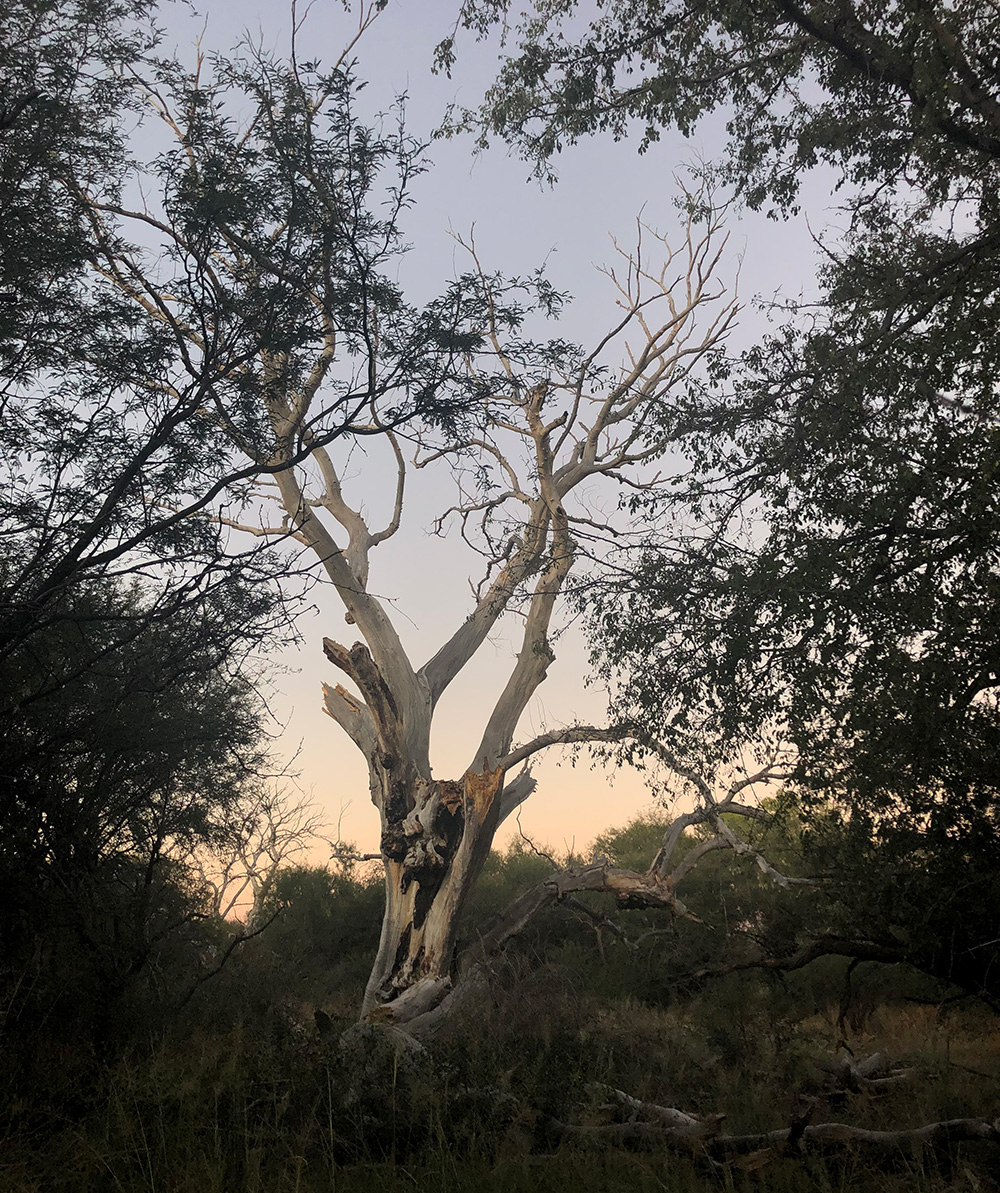
And even though they’ve been significantly changed, many of them remain ribbons of life where various ecological arrangements have taken hold. Migrating birds will still follow long-dry rivers to find their way. Species reemerge and reestablish, sometimes on their own and sometimes with human help. The Gila topminnow has done both in the Santa Cruz River: In 2015, it returned near Nogales after water quality improved, and in 2020 it was reintroduced to downtown Tucson.
Grief practitioner Holly Truhlar speaks to this: “Part of living in polycrisis is learning to accompany what’s ugly, scary, and overwhelming while staying attuned to what’s beautiful and sacred.”
This isn’t only about noticing the complexity and dynamism of the world around us. It’s also about practicing the skill of resourcing ourselves. When we keep our awareness tethered to life, abundance, and beauty while also engaging with what is troubling and grief-worthy, we create some buoyancy and balance in our lives. The more we can hold both, the more capacity we have to witness and attend to harsher realities of environmental loss. Processes of living, decaying, dying, and emerging are always occurring side by side and are deeply intertwined.
The Invitation
Visit a landscape, either known or new to you. Find a place to sit with a notebook. First, bring your attention to all you notice that’s thriving, alive, and resilient. “Map” this on the page in your own way — you could sketch it out or write about it. Then, bring your attention to where there’s been impact, disappearance, or injury on this same landscape. Place these on your map as well. Looking at your map as a whole, how do the parts interact or intersect? Are there any new ways you’re now seeing or understanding this landscape? How does it feel to notice all of these layers?
We encourage you to submit your response as a photograph or file so we can collectively share and witness landscapes and species, both thriving and struggling. Responses can be submitted anonymously or with your name and will later be available for public viewing. Thank you!