
This article first appeared in The Desert Leaf and is part of a series featuring the Sky Islands.
The longest documented path taken by an ocelot (Leopardus pardalis) was recently recorded in Arizona. According to a research paper by Eamon Harrity and Kinley Ragan published in March 2026, this male ocelot moved among four sky islands over a period of about 18 months, roaming a distance of at least 111 miles. The San Xavier District of the Tohono O’odham Nation aptly named this cat Himdam, meaning “traveler,” in recognition of the cat’s remarkable journey.
Himdam likely first ventured into Arizona from Sonora, Mexico, where the northernmost breeding population is known — 50 miles south of the U.S.-Mexico border. He first appeared on a Phoenix Zoo wildlife camera in the Atascosa Mountains in June 2024. Remarkably, he next graced a Center for Biological Diversity camera the following month in the Whetstone Mountains, 49 miles away from the previous camera sighting.
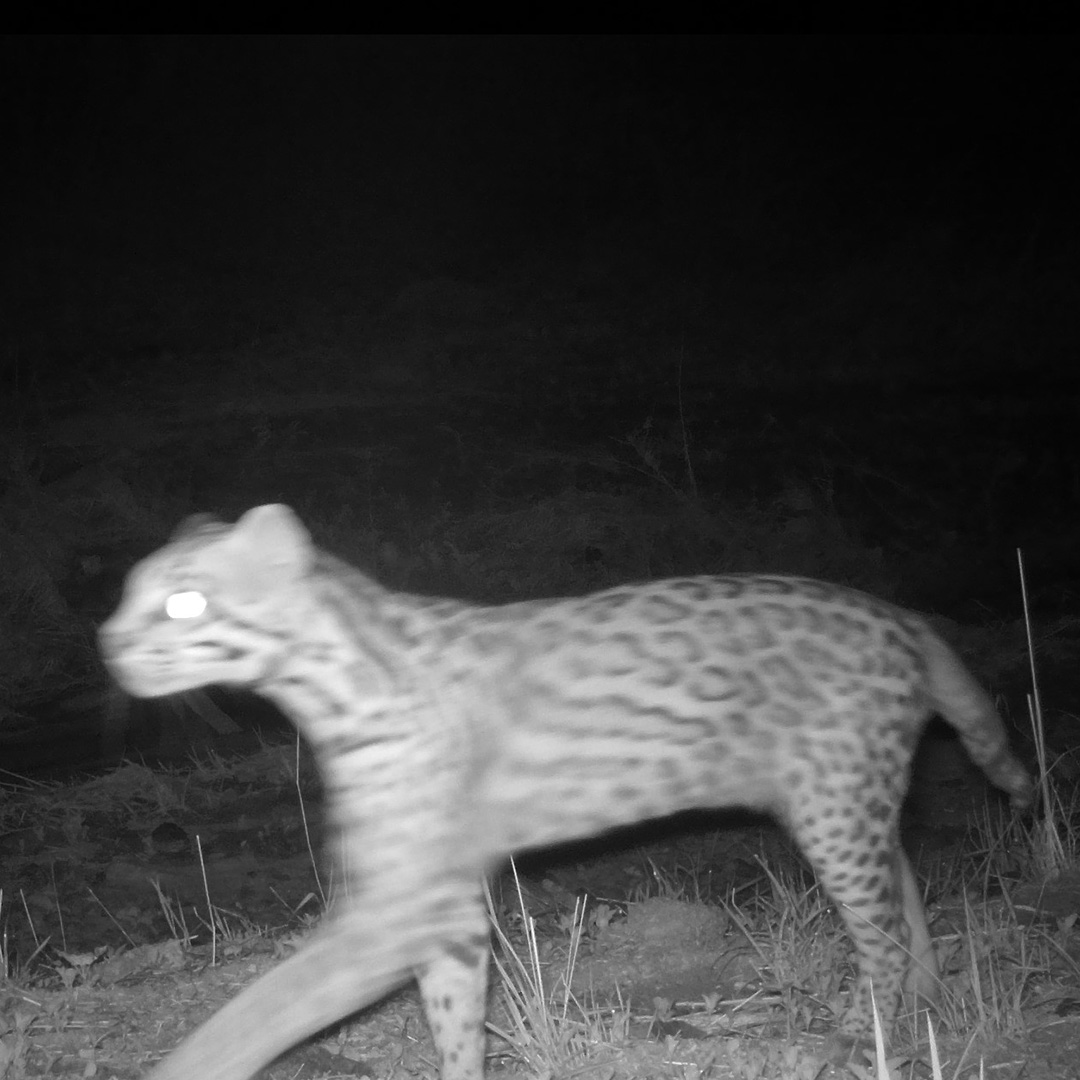
One year later, in July 2025, he appeared on a Sky Island Alliance camera in the Patagonia Mountains. Six days later, he showed up again on a University of Arizona Wild Cat Research and Conservation Center camera in the Santa Rita Mountains, nearly 20 miles north. This cat certainly made tracks among these mountains, crossing Interstate 19 and State Routes 82 and 83 (at least twice), during these known pitstops along his journey. To read Harrity’s and Ragan’s article on Himdam, visit Therya Notes.
Ocelots are a tropical cat, most commonly found in the forests of Central America and South America. The word ocelot comes from the Aztec Nahuatl word tlacoocelotl, meaning “tiger of the field” (see this Nahuatl Dictionary for more on this spelling). The animals’ distinctive coat patterns are unique to each cat — akin to humans’ fingerprints. Researchers study photos of ocelots taken by wildlife cameras to determine whether the arrangement and size of rosettes (rings of dark fur with lighter fur in the center), dark spots, and stripes on an ocelot’s coat match the pattern observed in any other ocelot photo, making it possible to confirm when the same cat is recorded in multiple locations. This matching helps researchers reconstruct the routes of these wandering felines across the landscape.
Ocelots are almost always photographed at night, as they are primarily nocturnal hunters, feasting on rodents and other small animals. Their complex coat patterns, like those of other spotted cats, provide excellent camouflage as they stalk prey in wooded areas. In Arizona, Himdam traveled through oak woodlands and desert scrub, traveling through the same habitats occupied by the other three felines of this region: mountain lion, jaguar, and bobcat.
Bobcats and ocelots are similarly sized, with females weighing 15 to 25 pounds and with males weighing about 34 pounds. The two species can look similar in photographs owing to their spotted coats, but ocelots have a narrower face, rosette-patterned fur on their shoulders that can appear chain-like, and a longer tail. An ocelot tail ranges from 10 to 16 inches long, while a bobcat tail measures only 5–7 inches.
Only seven ocelots are known to have roamed through Arizona since 2009, the year the first wildlife camera image was taken of one of the cats in the Whetstone Mountains by Sky Island Alliance. Since then, the solitary male ocelots that occupied southeastern Arizona have largely remained undetected by humans except for being captured by the cameras in the mountains, underscoring their rarity and the critical necessity to protect these lands.
Serving as confirmation of Himdam’s travels in multiple mountain ranges, these photos highlight the importance of providing safe and connected habitat for wide-ranging species throughout the Sky Islands. Ocelots, as well as jaguars, are endangered in the U.S. and Mexico. They also face many obstacles and dangers in our region, including open-pit mining, highways, and the border wall that isolates Arizona’s spotted cats from the rest of their population in Mexico.
Ocelots remain an elusive and rare presence in Arizona, but each photo offers a glimpse into the secret lives of these remarkable cats that occasionally roam our local mountains. To help make our mountains welcoming and safe for ocelots and all wild cats, we need to sustain the public land management agencies that conserve the land these cats depend on. When we keep water flowing in springs and rivers, and native plants thriving, and allow safe passage for cats across the landscape, we protect the rich biodiversity that makes this region so special.