

Guest Blog by Brit Rosso
After I retired as a federal wildland firefighter in 2019, I decided to start volunteering with Sky Island Alliance. As part of my volunteer work, I get to spend time exploring our Sky Islands and the surrounding lands. One of the many questions that crossed my mind as I explored these amazing mountains was: Who named these mountains? Many of our Sky Islands have names that sound Spanish to me. Some of the mountains have names that sound Indigenous. A few of the mountains have English names.
As my curiosity got the best of me, I decided to take a deeper dive into trying to answer the question of who named these mountains. I looked at old maps of New Spain, Mexico, and the Arizona Territory to see what I could find. Many of these mountains have had different names in the past or names that were close to their current name. For example, the Catalina Mountains were once called the “Sierra de Santa Catarinas” on an 1848 survey map. On that same map, the Canelo Hills, so called because of their cinnamon tones, were called the “Calabazas,” referring to the area’s native squash.
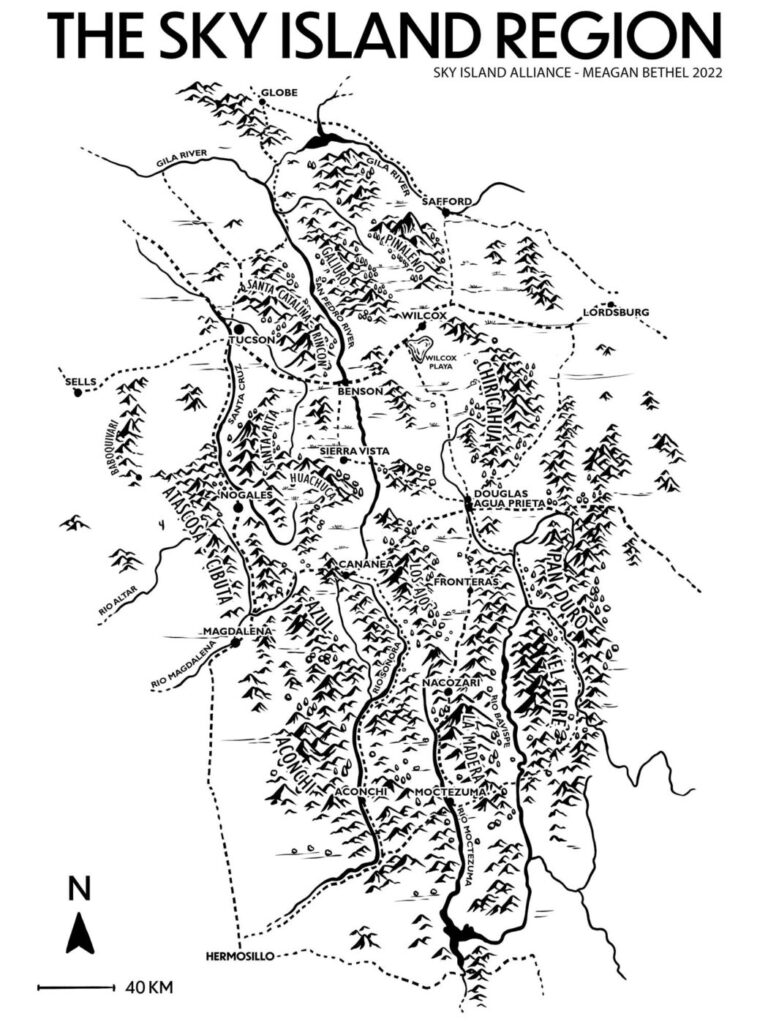
Below is a map made by SIA’s Wildlife Specialist Meagan Bethel, reflecting names in use in 2022.
As I dug deeper into this history, I came across a summary paper called “Who Named the Mountains?” This summary was written in 2020. The paper led me to a pamphlet of the same name, published by the Coronado National Forest in 2000, that went into greater detail on the history of the naming of our Sky Islands. After I read this pamphlet, this led me to a book from 1995 called Islands in the Desert — A History of the Uplands of Southeastern Arizona from which the pamphlet was sourced.
Over time I’ve learned even more about who named these mountains. New questions continue to pop into my head, wondering about the complex and often violent history when these mountains were named. It’s easier to find the current names of our Sky Islands, but what about the names from the past? It makes me wonder what the Hohokam people called these mountains. What do the past and present Indigenous people of these lands call these mountains?
In the 1500s, Spanish explorers arrived in the region. And later came Mexican soldiers and settlers, as well as various groups of other European settlers. These Sky Islands have been Indigenous lands for millennia before they became part of New Spain, then Mexico, and eventually Mexico and the United States. Maybe the question is not who named the mountains, but who gets to name the mountains? As I continue to explore these questions, I find myself struggling with our past history of conquistadors, soldiers, missionaries, and settlers. Winston Churchill’s famous quote “History is written by the victors” captures the idea that those who emerge victorious in conflicts have the power to shape and mold the historical accounts that future generations will come to know. So, do only the victors get to name the mountains?
I think the answer is way more complex and nuanced than that. Our Sky Islands of today have Indigenous, Spanish, and a few English names. Many of the mountains’ names have changed or evolved over time. For example, the Whetstone Mountains were once called the “Sierra del Babocomari,” an Ópata name. The Santa Rita Mountains were once called “Sierra de Santa Rita” as early as the 1760s. But to the Tohono O’odham people, the name of these mountains for thousands of years has been and continues to be Ce:wi Duag (pronounced “choo duh awg”), which translates to “Long Mountain.” The Western Apaches name for the Santa Ritas is Dzif enzho, which means “Beautiful Mountain.”
As far back as 1695, the Chiricahua Mountains were called the “Sierra de Chiricahua” (or Chiricahui). In the Ópata language, Chiricahua means “mountain of the wild turkeys.” We are fortunate that the Spanish, Mexican, and European explorers took the time to document some of the Indigenous names for these mountains. The brutal reality is that for most cultures who use oral and not written history, if that culture becomes assimilated into another culture or just disappears, most of their culture, language, and history is lost. The Ópata people are just one example of what is lost, once the culture becomes assimilated. Here’s a quote from David Yetman’s book The Ópatas — In Search of a Sonoran People: “In 1600 they were the largest, most technologically advanced indigenous group in northwest Mexico, but today, though their descendants presumably live on in Sonora, almost no one claims descent from the Ópatas.”
As a volunteer with Sky Island Alliance, I spend quite a bit of time in the borderlands. There are times when I’ll stop whatever I’m doing and turn my gaze to the south. There is one prominent Sky Island that I’m familiar with, called Sierra San José, just southwest of Naco, Sonora. As I continue to scan the southern horizon, I can see more and more mountains popping up out of the desert. I have to remind myself that there are more Sky Islands in Mexico than there are in Arizona and New Mexico combined.
My personal journey in regards to learning about who named the mountains has just begun. One of the many lessons I’ve learned about life is that every day is a school day. If you have interest in learning more about who named the mountains, check out the resource list below.
Further Reading
- Who Named the Mountains? (summary paper)
- Who Named the Mountains? (Coronado National Forest pamphlet)
- Islands in the Desert: A History of the Uplands of Southeastern Arizona by John P. Wilson
- The Ópatas — In Search of a Sonoran People by David Yetman
- Arizona Place Names by Will C. Barnes (also available as PDF)
- O’odham Place Names by Harry Winters, Jr. (also available at the library)
- To the Corner of the Province, A Green Band in a Parched and Burning Land + article on primary narrative texts (Dr. Deni Seymour)
- Maps of New Spain (1815), Mexico (1847), Arizona Territory (1876) (David Rumsey Map Collection)
- Native Land Digital — a tool mapping Indigenous territories across the globe.
Brit Rosso is a volunteer with Sky Island Alliance and has been helping with the organization’s Border Wildlife Study, Spring Seeker, and FotoFauna projects since fall 2019, shortly after he retired from 35 years of service as a federal wildland firefighter.